
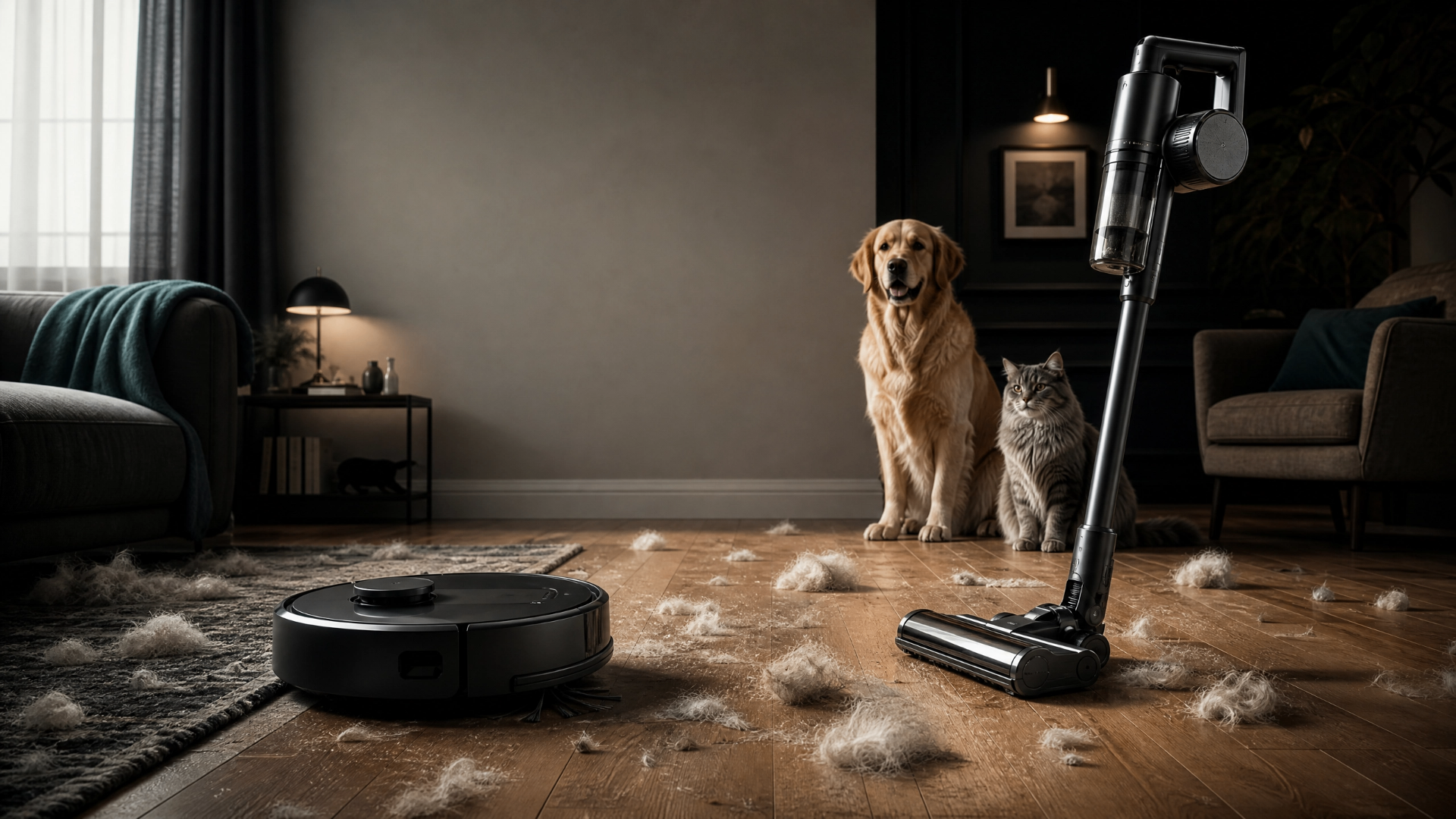
You love your dog. You love your cat. You do not love the furry tumbleweeds rolling across the living room like unwanted extras in a dusty Western.
Sooner or later, every pet owner hunting for the best vacuum for pet hair reaches the same showdown: robot vacuum vs. cordless vacuum for pet hair. One promises to patrol the floors while you do literally anything else. The other offers a human-guided attack on carpets, couches, stairs, corners, and every other place your pet has generously upholstered.
So which one should you buy?
The short answer: Choose a robot vacuum for automatic daily control of loose fur on accessible floors. Choose a cordless stick if this will be your only vacuum or if carpet, furniture, stairs, and cars are part of the battlefield. In a heavy-shedding home, the best setup is often a robot for frequency plus a stick or full-size vacuum for deep cleaning.
We reached that verdict by reviewing current expert tests and buyer guides—not by pretending that one type of vacuum can do everything. Here is how the two machines perform when the fur starts flying.
Quick Comparison
| Pet-hair job | Robot vacuum | Cordless stick vacuum |
|---|---|---|
| Daily loose fur on hardwood or tile | Excellent when scheduled frequently | Excellent, but only when someone uses it |
| Embedded hair in carpet | Varies widely by model and carpet | Usually the stronger choice for a focused deep clean |
| Couches, pet beds, and upholstery | Cannot reach them | Excellent with a powered pet tool |
| Stairs and cars | Cannot clean them | Designed for these jobs when converted to handheld mode |
| Hands-off cleaning | The clear winner | Requires your time and steering |
| Toys, cords, bowls, and pet accidents | Depends heavily on obstacle avoidance | You see and avoid hazards yourself |
| Best role | Daily floor-maintenance system | Flexible whole-home cleaning tool |
Meet the Suspects
The Patrol Bot is an autonomous floor cleaner. Depending on the model, it can map rooms, follow schedules, detect carpet, return to its charger, and empty its dustbin into a dock. Its advantage is not that it always cleans harder. Its advantage is that it can clean more often with almost no effort from you.
The Fur Sheriff is a battery-powered stick vacuum that usually converts into a handheld. You supply the navigation, but that human steering gives it range: floors, baseboards, upholstery, stairs, pet beds, car seats, and the mysterious crack beside the couch where kibble goes to retire. Current comparison guides consistently position cordless sticks as the more versatile option for targeted messes and above-floor work.
Round 1: Daily Loose Fur on Hardwood and Tile
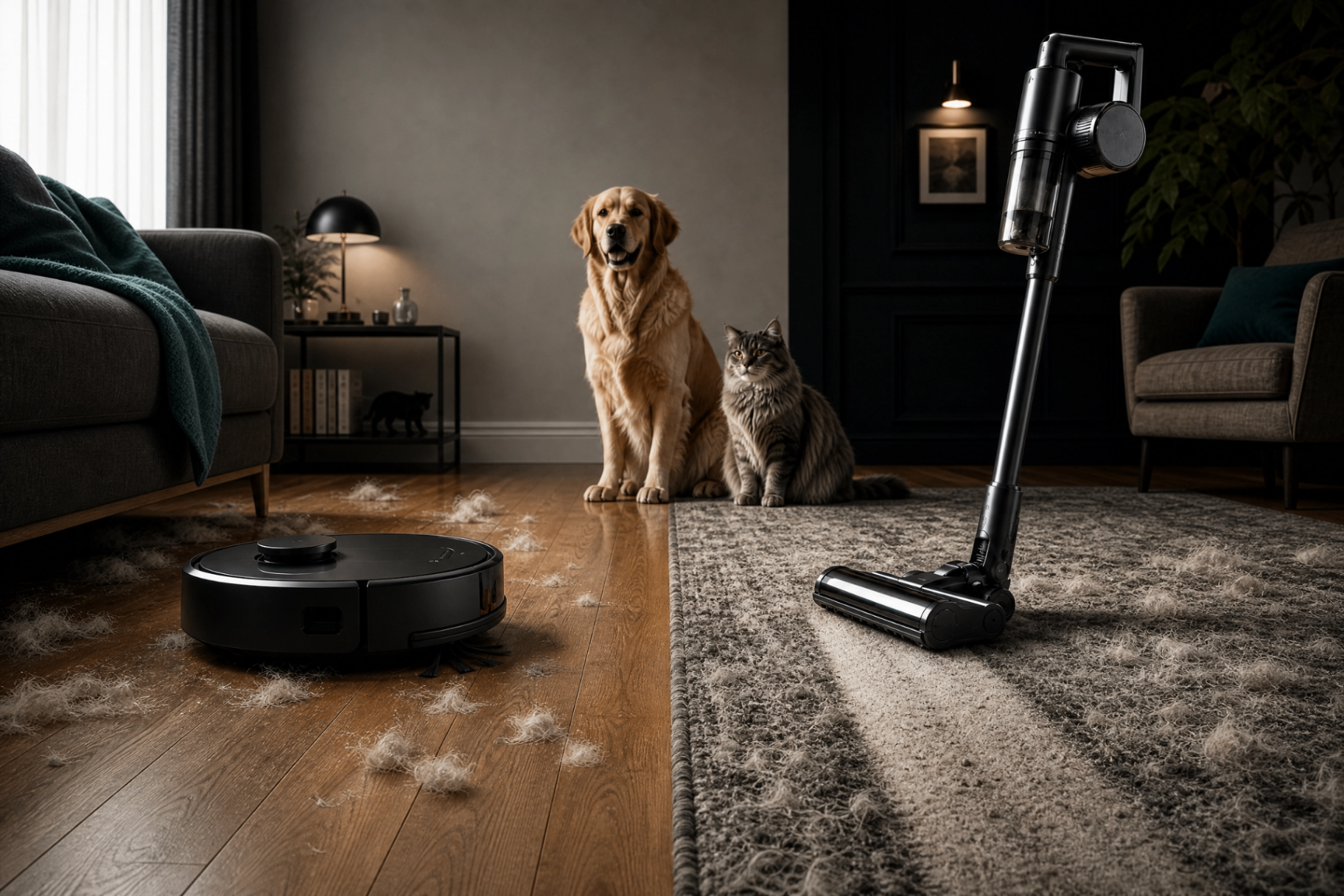
This is where the robot vacuum earns its keep. Loose fur on hard floors is a recurring maintenance problem, not a once-a-week emergency. A scheduled robot can make a pass every day—or even more than once a day—before hair has time to gather into visible clumps.
A good cordless stick can clean the same floor quickly, but only after you retrieve it, steer it, empty it, and put it away. If your real obstacle is not suction but motivation, the robot has a major practical advantage. A machine that runs is more useful than a stronger machine watching you from the closet.
Round winner: Robot vacuum. For routine loose fur on open hard floors, consistency is the superpower.
Round 2: Do Robot Vacuums Pick Up Pet Hair on Carpet?
Yes—but the honest answer is "some do, and the carpet matters." Current robot-vacuum testing shows substantial model-to-model differences in pet-hair pickup on carpet. Brush-roll design can matter as much as headline suction claims, and results can change between low-pile and thicker carpet.
A robot may keep surface fur under control if it runs frequently. Hair already embedded in a dense rug is a different crime scene. A cordless stick lets you slow down, make overlapping passes, use a more aggressive floor head, and concentrate full power on the worst area. That human-guided agitation is difficult for a small autonomous machine to match.
If your home is mostly carpet and your Labrador appears to be manufacturing a second Labrador every week, start with a capable stick or full-size vacuum. Treat a robot as maintenance support, not as your only deep cleaner.
Round winner: Cordless stick vacuum. Robots can maintain many carpets, but the stick is the safer single-machine choice for embedded fur.
Round 3: Couches, Pet Beds, Stairs, and Cars
Robot vacuums are floor specialists. They cannot climb stairs, clean sofa cushions, chase hair along the back of a chair, or detail the car after your dog's joyful trip to the muddy park.
A cordless stick normally converts into a handheld, and a powered mini brush can agitate fur from upholstery and carpeted steps. Pet-hair guides repeatedly evaluate these tools because hair on furniture is not a side problem—it is often the reason people need a pet-specific vacuum in the first place.
Round winner: Cordless stick vacuum. Robots still do not have arms.
Round 4: Anti-Tangle Brushes and Maintenance
Both categories now advertise anti-tangle rollers, combs, cutters, rubber fins, and other defenses against the ancient enemy known as Hair Wrapped Around a Cylinder. Those features are worth considering, especially in homes with long-haired pets or humans. Independent buying guidance also recommends prioritizing a removable or self-cleaning brush roll when tangles are a regular problem.
Do not confuse anti-tangle with maintenance-free. Every vacuum still needs attention. Check the brush roll, clear the intake, clean or replace filters on schedule, and empty the bin before compacted fur turns it into a tiny beige brick. Robot vacuums add wheels and sensors that also need occasional cleaning; cordless sticks make most problem areas easier to inspect by hand.
If your current machine sounds angry but collects nothing, visit How to Make Your Vacuum Suck Again before declaring it legally dead.
Round winner: Draw. Buy a design that makes the brush roll accessible, regardless of vacuum type.
Round 5: Toys, Cords, Bowls, and the Poopocalypse Clause
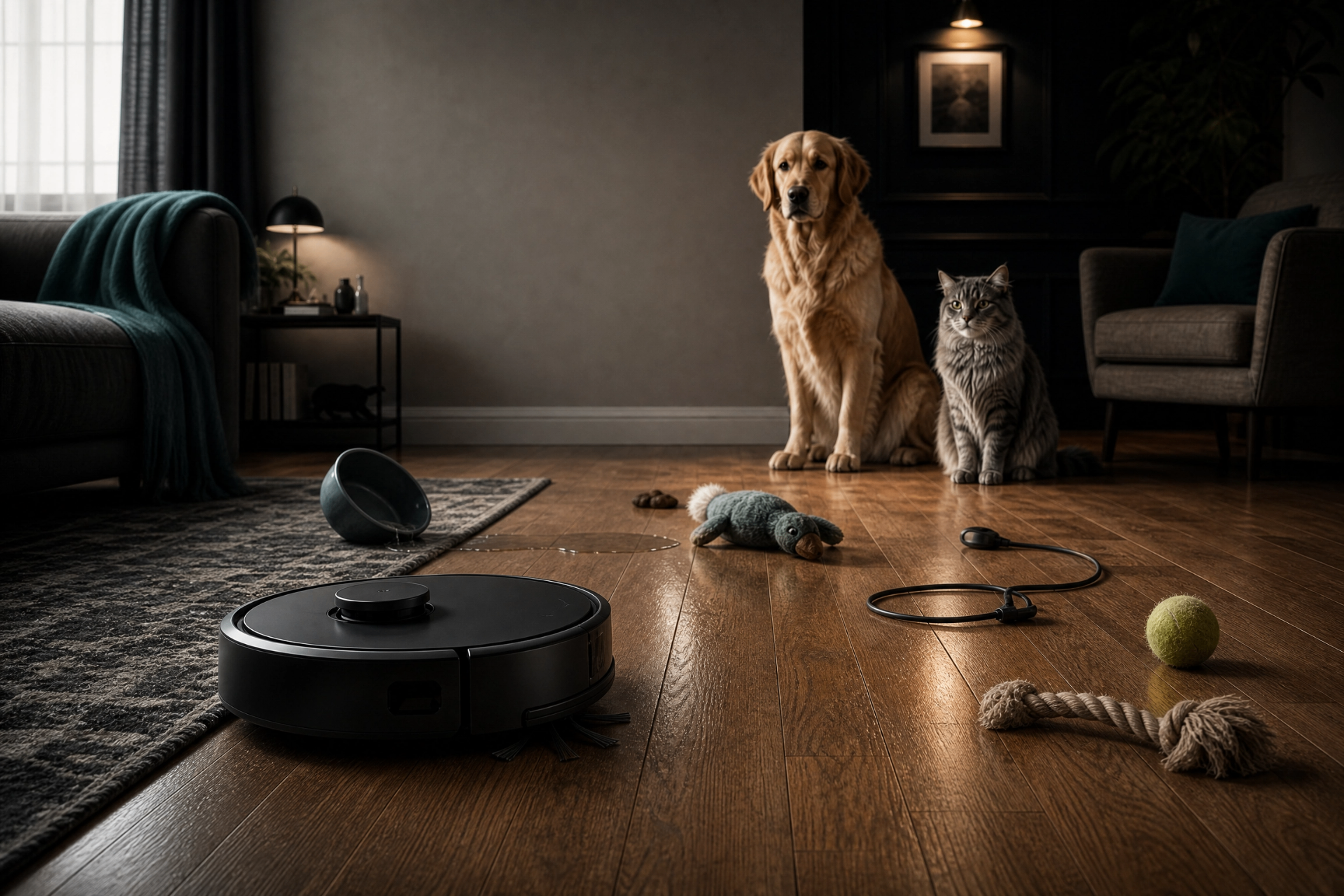
Pets leave obstacles. Some squeak. Some charge by USB. Some should never meet a spinning brush roll under any circumstances.
A cordless stick avoids hazards because you are driving. A robot relies on its sensors and software. Premium robots increasingly use cameras or other obstacle-detection systems to recognize cords, toys, and pet waste, but performance varies, and no responsible owner should assume that every object will be identified every time.
That brings us to the Poopocalypse Clause: if an unsupervised robot fails to detect a pet accident, it can transform one contained problem into an open-plan disaster. Owners with puppies, older pets, or animals that occasionally have accidents should prioritize independently tested waste avoidance—or inspect the floor before every scheduled run.
Round winner: Cordless stick vacuum for certainty; premium robot vacuum for convenience with precautions.
Round 6: Cost, Batteries, and the Price of Your Time
Price tags vary too much by model and sale cycle to crown a permanent winner. Basic machines exist in both categories, while feature-heavy flagships can become expensive quickly. For robots, self-emptying docks, advanced navigation, mopping hardware, and object recognition raise the price. For cordless sticks, stronger motors, additional batteries, premium filtration, and powered attachments do the same.
The more useful comparison is what each machine asks from you. A robot asks for floor preparation, app setup, occasional rescue, dock maintenance, and regular brush cleaning. A cordless stick asks you to do the actual vacuuming and manage battery runtime. One charges you in setup and complexity; the other charges you in minutes of your life.
Round winner: Your personal tolerance for vacuuming. There is no universal bargain if the cheaper machine does not solve your actual problem.
Which Vacuum Should You Buy?
| Your home | Best starting choice | Why |
|---|---|---|
| Mostly hard floors with open rooms | Robot vacuum | Frequent automated passes can keep loose fur from accumulating. |
| Mostly carpet with a heavy shedder | Cordless stick or full-size vacuum | You need focused agitation and stronger deep-cleaning ability. |
| Multi-level home with carpeted stairs | Cordless stick vacuum | It can travel between floors and convert for stair cleaning. |
| Pets sleep on furniture | Cordless stick vacuum | A powered upholstery tool reaches where a robot cannot. |
| Busy household that already owns a deep cleaner | Robot vacuum | It can handle daily maintenance between manual cleanings. |
| Heavy shedders plus mixed flooring | Both, if the budget allows | The robot controls daily fur; the stick handles carpet and above-floor cleaning. |
| Puppy, senior pet, or frequent floor accidents | Cordless first | You avoid hazards yourself; add a robot only after verifying obstacle performance. |
The Pet-Hair Features That Actually Matter
For a robot vacuum, prioritize a brush system with documented pet-hair performance, reliable navigation, accessible brush-roll maintenance, and enough bin capacity for your shedding level. A self-emptying dock can reduce how often you handle fur, but it does not eliminate dock-bag costs or maintenance. If accidents are possible, obstacle avoidance deserves more weight than another impressive-looking suction number.
For a cordless stick, look for a motorized floor head, an anti-tangle or easily removable roller, a powered upholstery tool, and a battery that can cover your real cleaning route. Filtration also matters in homes where pet dander is a concern, but examine the entire sealed system rather than assuming that one filter label guarantees the machine will contain every particle.
For either type, the most useful evidence is independent testing on your surfaces. A vacuum that excels on hardwood can disappoint on carpet, and a machine that devours short dog hair may respond differently to long cat fur. Our vacuum buying guide can help you translate those differences into a sane shortlist.
Final Verdict: Frequency vs. Flexibility
The winner of robot vacuum vs. cordless vacuum for pet hair depends on the job you are hiring it to do.
Choose a robot vacuum when your biggest enemy is loose fur returning to accessible floors every day. Automation lets the machine fight that battle more consistently than most humans will.
Choose a cordless stick vacuum when you need one flexible machine for carpet, furniture, stairs, corners, pet beds, and cars. It demands your time, but it follows your eyes and reaches far beyond the floor.
Choose both when your pets shed heavily, your home has mixed surfaces, and your budget allows it. The robot becomes the daily patrol; the stick becomes the cleanup crew. Neither gets to retire, because your pet has already started shedding again.
Take Our Vacuum QuizFrequently Asked Questions
Is a robot vacuum worth it for pet hair?
A robot vacuum can be worth it when loose fur collects on hard floors or low-pile carpet and you will use scheduling to run it frequently. It is less convincing as your only vacuum if your home has stairs, thick carpet, fur-covered furniture, or many areas the robot cannot reach.
Is a robot vacuum or cordless vacuum better for dog hair?
A robot is better for automatic daily maintenance on accessible floors. A cordless vacuum is better for a whole-home attack on dog hair because it can clean carpet, stairs, couches, pet beds, and cars. Heavy-shedding homes often benefit from using both.
Do robot vacuums work on pet hair on carpet?
Many do, but performance varies by model, brush design, and carpet type. Frequent runs can control surface fur. A human-guided stick or full-size vacuum is still the more dependable choice for deeply embedded hair.
Which matters more for pet hair: suction or an anti-tangle brush?
Both matter, but suction alone does not tell the full story. Brush-roll agitation, floor contact, airflow, hair resistance, and maintenance design all affect real pickup. Prioritize independent pet-hair tests over one isolated specification.
Can a robot vacuum avoid pet waste?
Some premium models are designed to recognize and avoid pet waste, but detection is not guaranteed in every room or lighting condition. Check current independent obstacle-avoidance tests for the exact model and inspect the floor before an unattended run when an accident is possible.
Do I need a self-emptying robot vacuum for pet hair?
You do not strictly need one, but the feature is particularly useful in a heavy-shedding home because a robot's onboard bin can fill quickly. The tradeoffs are a larger dock, ongoing bag costs on many models, and another component to maintain.
Editorial Note
This article synthesizes current independent tests and comparison guidance. It does not claim that every robot or every cordless stick performs identically, and it is not a substitute for model-specific testing. Product features, prices, and software can change; verify the current specifications before buying. See How We Rate Vacuums for our editorial approach.